01
Water first
Know how much to plan for, where to start and what to do when water is hard to find.
LEARN THE BASICS →
ORDINARY PEOPLE. A MORE PREPARED TOMORROW.
Start with a 15-minute check. Identify three priorities, use what you own, and leave with a practical action list.
ONE SMALL STEP TODAY. NO EMAIL REQUIRED.
ONE AFTERNOON. A WORKING FIRST DRAFT.
An afternoon is time to make a first plan, not a guarantee that every household need will be resolved.
Answer six practical questions. Get three priorities and one action that costs nothing.
Check the cupboards, find the working light and talk through your contact plan.
Use your free action list or the starter worksheets. Give each action an owner and a review date.
Know how much to plan for, where to start and what to do when water is hard to find.
LEARN THE BASICS →Find your lights, check your batteries and make a plan for staying informed.
PREPARE FOR AN OUTAGE →Agree on a meeting place. Write down the contacts and everyday details that matter.
MAKE A SIMPLE PLAN →PREPARATION, WITHOUT THE OVERWHELM
If power, water or stores become unavailable, what does your household need first? Start with one cupboard, one working light and one conversation.
Then build a plan around your space, your people and your budget. This is for apartments and houses, individuals and families, with pets and without.
PLAN FOOD YOU CAN ACTUALLY USE →01 / WATER FIRST
An empty store shelf does not tell you whether your tap water is safe. Check your utility or local health department before choosing your next step.
Check your water utility or local health department for advisories. If tap water is confirmed safe, use it and fill suitable containers cleaned and sanitized using CDC’s instructions. Label the date. Do not use containers that held chemicals.
A boil-water notice is different from a do-not-drink or do-not-use notice. Do not assume boiling solves every problem: it cannot make water containing fuel or toxic chemicals safe. Use the alternative source recommended by officials.
Check your utility and local emergency management for current water distribution sites or assistance. Confirm locations, hours and access before traveling. Do not assume a nearby site is operating.
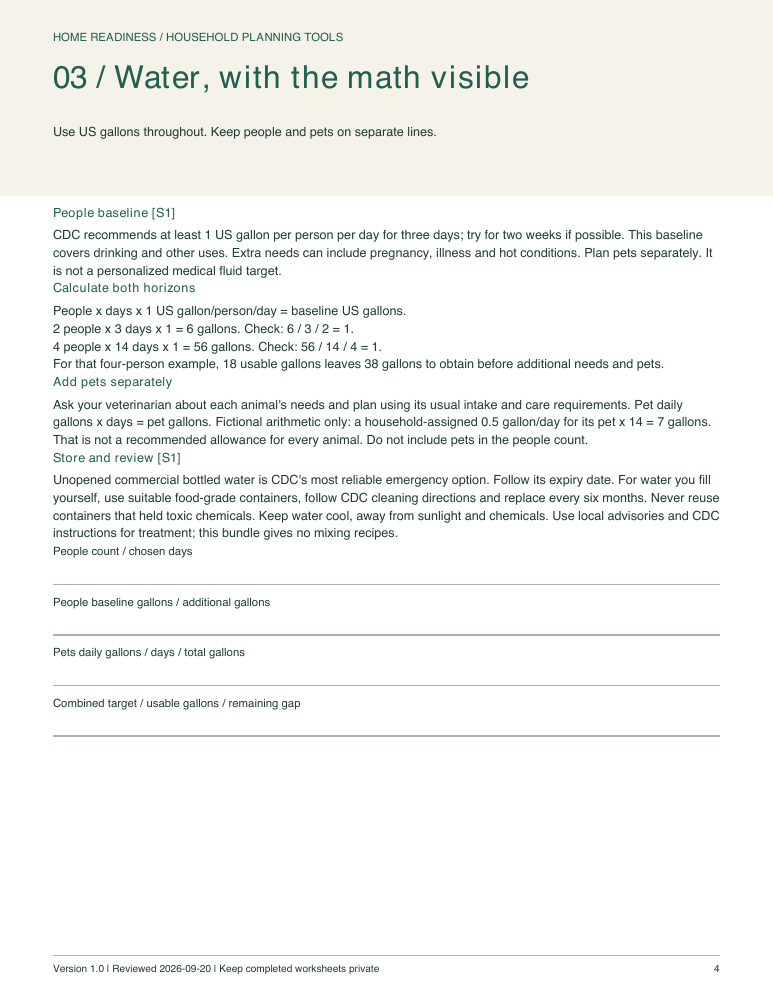
CDC’s baseline is at least 1 US gallon per person per day for 3 days; try for two weeks if possible. Four people: 12 gallons for 3 days, or 56 gallons for 14 days. Allow more for additional needs; plan pets separately.
Store self-filled water safely and replace it every six months. A normal pitcher filter is not a universal emergency treatment. If treatment is needed, follow current official instructions for the actual hazard.
Official guidance, checked September 20, 2026: CDC storage and container instructions ↗ · CDC emergency water safety ↗ · CDC water advisory types ↗. Keep these instructions available offline.
One organized bundle
General emergency guidance is available free. The paid value here is the organization: clear priorities, reusable worksheets and a plan you can make your own.
Do-today checklist, household inventory and a budget-first shopping worksheet.
Water calculations, food planning, lighting, charging, sanitation and seasonal needs.
Contacts and reunification, children, pets, documents and accessibility needs.
Separate home and go-bag lists, maintenance calendar and linked official sources.
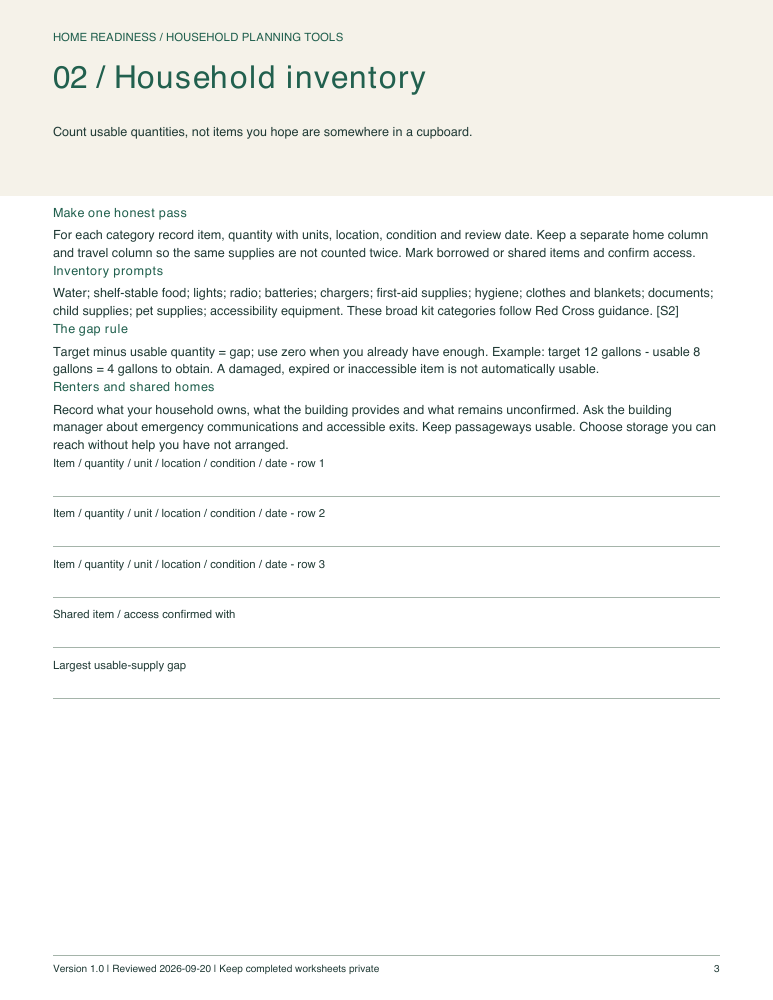
Two excerpts from the US Letter edition: household inventory and the water-planning worksheet. The bundle includes 15 pages plus the editable workbook.
One digital bundle. One-time purchase.
No subscription or physical supplies.
Secure checkout and instant download through Gumroad. Review the seller’s terms before purchase.
View the Gumroad listing ↗Full listing, files and seller terms on Gumroad.
Prepared files: 15-page US Letter and A4 PDFs, accessible HTML reading version and an editable offline HTML workbook with a “Save completed copy” option. No paid software subscription required. The bundle is listed on Gumroad for $29 USD. Gumroad handles payment and digital delivery; any applicable tax and the final total appear at checkout.
OFFICIAL GUIDANCE COMES FIRST
This is a planning tool, not an emergency alert service. Three days is a starting point, not a guarantee that it is enough. Follow current local instructions on shelter, evacuation and safe water.
Use the water steps above, then take the free one-page checklist through your home. Find a working battery light, no-cook food your family eats, and a paper contact list. Choose one missing essential and one task you can finish today.
Yes. The free starter checklist requires no email address. Ready.gov, CDC and the Red Cross also provide free emergency guidance. Use official local instructions during an actual emergency.
The worksheets begin with what you have and help you prioritize. Adapt the plan to storage, access, household needs and budget. Two weeks is a planning target, not a requirement to buy everything today.
No household worksheets are submitted to this website. Complete and save the files on your own device. Keep completed contact, accessibility and document worksheets somewhere private.
Gumroad handles payment and access to the digital files. Keep your Gumroad receipt so you can return to your download. The published listing is offered by Tyler Brewton; the purchase button on this site shows current checkout availability. For help with access, email tylerbrewton@gmail.com with your receipt or order identifier, not your completed household worksheets.
Tyler Brewton offers a 30-day refund policy. To request a refund within 30 days of purchase or get product support, email tylerbrewton@gmail.com and include your Gumroad receipt or order identifier. See the seller, refund and privacy policies for details. Your statutory rights are not affected.
A SMALL STEP IS STILL A START.
15 minutes. No account. No household answers uploaded.